

|
Quantity
|
Total
|
||
|
|
|||
|
|
|||
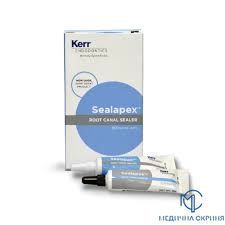
Sealapex (Kerr): Revolutionary Calcium Hydroxide Sealer for Biological Root Canal Obturation
Sealapex (Kerr) is a classic, clinically proven, two-component (paste-paste) endodontic sealer based on calcium hydroxide, developed by Kerr (USA). This material plays a key role in permanent root canal obturation, offering a unique combination of excellent sealing, ease of use, and, most importantly, biological activity aimed at stimulating healing and regeneration processes. The sealer comes in a convenient system of 12 g Base and 18 g Catalyst, which provides the controlled mixing and working time necessary for precise placement and gutta-percha condensation.
Technological Basis and Composition Unlike many traditional sealers, Sealapex is built on a cement-resin matrix enriched with highly active calcium hydroxide (Ca(OH)2). It is this component that ensures its exceptional biological properties.
Active Component – Calcium Hydroxide: The high concentration of calcium hydroxide is the heart of the Sealapex formula. After mixing and setting, the material ensures the continuous release of calcium ions and hydroxide ions. Two-Component System (Paste-Paste): This chemical setting system guarantees complete polymerization regardless of canal depth or the presence of moisture, which is not always achieved with light-curing materials in narrow endodontic spaces. Radiopacity: The inclusion of radiopaque fillers provides clear visualization of the filling on X-rays. This is critically important for postoperative control and assessment of the quality of obturation, making it easy to distinguish the sealer from gutta-percha and tooth tissues.
Key Advantages and Uniqueness
Biological Activity and Apexogenesis: The main advantage of Sealapex lies in its ability to be bioactive. The release of hydroxide ions creates an alkaline environment (pH > 11), which has three important biological consequences: Stimulation of the Apical Barrier (Apexification): In cases of incomplete root formation (immature apex) or trauma, the sealer stimulates periodontal ligament cells (fibroblasts) to form a hard tissue barrier (apical cementum or dentin) at the root apex. This ensures a reliable biological closure of the apical foramen. Anti-inflammatory Action: The alkaline environment helps neutralize acidic bacterial products, reducing inflammation in the periodontium. Antibacterial Effect (Cleaning): A high pH level is a powerful antimicrobial agent, effectively destroying remaining bacteria and their toxins that may be present even after instrumentation. Excellent Sealing and Low Shrinkage: Sealapex ensures high-quality sealing of the canal, which is the main criterion for successful endodontic treatment: Minimal Shrinkage: The material exhibits very low polymerization shrinkage. This guarantees that the filling material maintains its volume and adheres tightly to the canal walls and gutta-percha, preventing microleakage. Good Flow: The optimal consistency allows the sealer to effectively penetrate the complex anatomy of the root canal, including lateral canals and dentinal tubules, ensuring complete obturation. Ease of Use: The paste-paste system significantly simplifies the clinical process: Controlled Setting Time: Unlike zinc-eugenol sealers, the working time of Sealapex is sufficient for gutta-percha placement and the use of lateral or vertical condensation techniques, but setting occurs quickly after placement in the canal. Easy Mixing: The base and catalyst are easily mixed on a glass slab or mixing pad, allowing for precise control of proportions and the achievement of a uniform consistency.
Indications for Use Sealapex is a standard in endodontics and is used for:
Permanent Root Canal Obturation: As a sealer in combination with gutta-percha points (lateral and vertical condensation techniques). Treatment of Immature Roots (Apexification): Due to its ability to stimulate the formation of a hard apical barrier. Repair of Perforations: Can be used to close small perforations in the root or furcation (although MTA is the modern gold standard, calcium hydroxide sealers are historically important).
Important Aspect: Removal Characteristics Although Sealapex has many advantages, its calcium hydroxide base is water-soluble. Over time, under the influence of tissue fluid, slow dissolution of the material (degradation) may occur. However, in well-obturated and hermetically sealed canals, the clinical significance of this process is minimal. In case retreatment (re-endo) is necessary, Sealapex is relatively easy to remove from the canal, which is an advantage compared to non-dissolving resin sealers. Sealapex (Kerr) remains one of the most reliable and popular sealers worldwide due to its unique ability to combine high sealing effectiveness with active biological stimulation of healing and tissue regeneration.